 Explore the Heart of South Africa: Nature, Culture, Adventure
White Rhino / Square-lipped Rhino
Afrikaans name: Wit Renoster
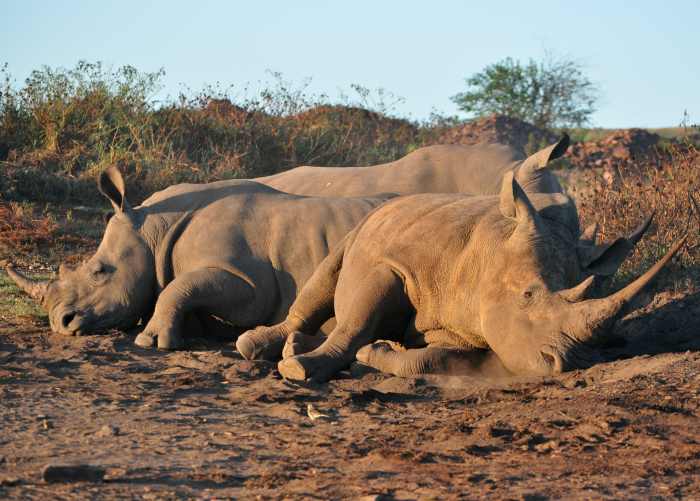
White or Square-lipped Rhino
Photo © Steven Herbert
Ceratotherium simum
Interesting facts about White Rhinos
Another, more appropriate, name for the White Rhino is Square-lipped Rhino. The Black Rhino would then be Hook-lipped Rhino.
There is a lot of speculation about where the name of White Rhino comes from. One theory is that it is derived from the Dutch word 'Wijd' which means wide and not white.
Males can reach up to 4 metres in length. Females are a bit smaller. At the shoulder they can be up to 1.8 metres in height. Males weigh around 2,300 kg.
White Rhinos have two horns. The front one is the longest and can, in extreme cases, be up to 1.5 metres in length.
The preferred habitat of the White Rhino is savanna or open grassland. Their main food is grass.
Rhinos are well-known for the dung middens they make. These are spots in their range where they will drop their dung. These middens can often be seen on or alongside roads in game reserves. Males have well-defined territories which they will defend from other males.
White Rhino need a lot of water and males will allow other males to pass through their territories to go and drink or wallow in the mud.
White Rhinos may be seen by themselves or in small herds.
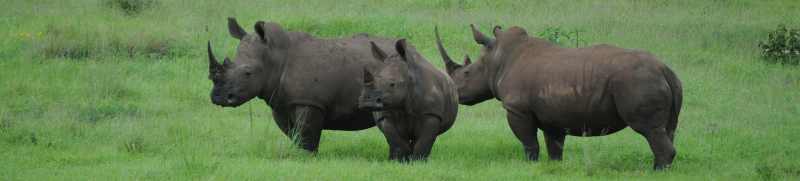
Photo © Steven Herbert
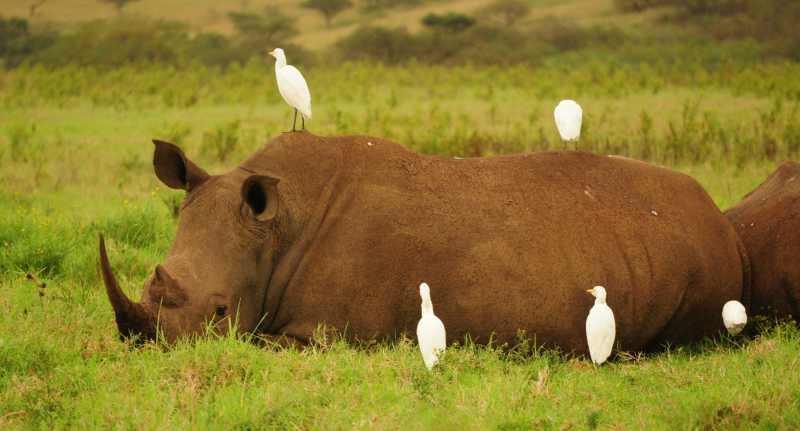
Photo © Steven Herbert
Above - What does it take for a tired White Rhino to get some peace and quiet? Photographers in noisy diesel bakkies and pesky Cattle Egrets are interrupting my sleep! Cattle Egrets are sometimes called Tickbirds because they eat ticks off large mammals. The Cattle Egrets also keep close to larger mammals to catch any prey items flushed out by the larger animal.How do you tell Black and White Rhino apart?
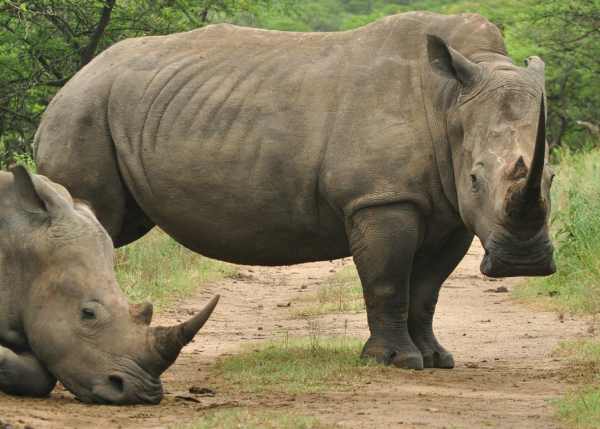
Photo © Steven Herbert
Firstly, don't go by colour. Ignore the white and the black bits of their name! Rather look at the head shape. The White Rhino (above) has a log heavy-looking head that hangs down (remember it eats grass). The mouth is also square. The Black Rhino (below) has a smaller head that is held higher. The mouth is pointed.
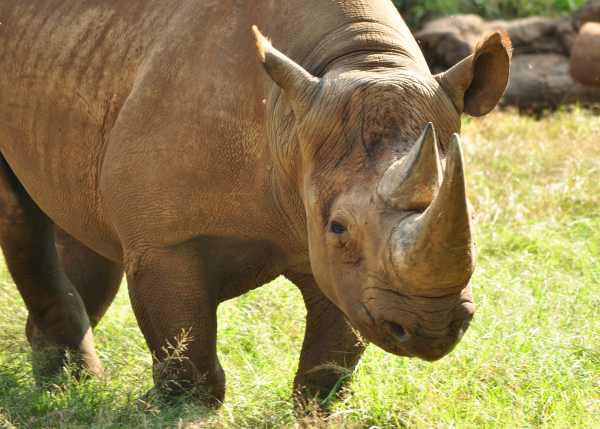
Photo © Steven Herbert
References and further reading
Wildlife of Southern Africa - Author: Martin Withers and David Hosking - Published: 2011 - Page: 218Wild Ways - 2nd Edition - Author: Peter Apps - Published: 2000 - Page: 127
The Rough Guide to Game Parks of South Africa - Author: P. Briggs - Published: 2020 - Page: 340
Tracks and Tracking in Southern Africa - Author: Louis Liebenberg - Published: 2000 - Page: 90
The Natal Bushveld - Volume 2 - Author: Natal Parks Board - Published: 1981 - Page: 11
South African Animals in the Wild - Author: Anthony Bannister - Published: 1985 - Page: 59
The Mammal Guide of Southern Africa - 2nd Edition - Author: Burger Cillie - Published: 2011 - Page: 102
Signs of the Wild - 5th Edition - Author: Clive Walker - Published: 1996 - Page: 130
Signs of the Wild - 3rd Edition - Author: Clive Walker - Published: 1986 - Page: 133
Questions and Answers - Mammals of Southern Africa - Author: Deirdre Richards - Published: 1990 - Page: 7
Reader s Digest Illustrated Guide to Southern Africa - 4th edition - Author: - Published: 1986 - Page: 355
Pollinators, Predators and Parasites - Author: C. Scholtz, J. Scholtz, H. De Klerk - Published: 2021 - Page: 245
Questions and Answers - Endangered Wildlife of Southern Africa - Author: John Comrie-Greig - Published: 1992 - Page: 31
Mammals of Southern Africa - Author: Burger Cillie - Published: 1987 - Page: 69
Mammals of the Kruger and other National Parks - Author: The National Parks Board - Published: 1980 - Page: 74
Maberly s Mammals of Southern Africa - Revised edition - Author: Richard Goss - Published: 1986 - Page: 193
Land Mammals of Southern Africa - A field guide - Author: Reay HN Smithers - Published: 1986 - Page: 139
KwaZulu-Natal - A celebration of biodiversity - Author: Ezemvelo KZN Wildlife - Published: 2002 - Page: 119
Kruger National Park, Visitor s Map 1996 - Author: - Published: 1996 - Page: 2
Kruger National Park Questions and Answers - Author: P.F. Fourie - Published: 1987 - Page: 198
Illustrated Guide to the Game Parks and Nature Reserves of SA - 2nd edn - Author: Reader s Digest - Published: 1991 - Page: 414
go! - Kruger - Author: - Published: 2017 - Page: 13
Hit the Road - 2nd Edition - Author: MapStudio - Published: 2018 - Page: 147
Getaway Guide to the Kruger National Park - Author: Cameron Ewart-Smith - Published: 2005 - Page: 194
First Field Guide to Animal Tracks of Southern Africa - Author: Louis Liebenberg - Published: 2003 - Page: 40
Game Ranger in your Backpack - Author: Megan Emmett and Sean Pattrick - Published: 2013 - Page: 32
Field Guide to the Mammals of the Kruger National Park - Author: U. de V. Pienaar et al. - Published: 1987 - Page: 100
Field Guide to the Larger Mammals of Africa - 1st Edition - Author: Chris and Tilde Stuart - Published: 1997 - Page: 78
Field Guide to the Mammals of Southern Africa - 3rd Edition - Author: Chris and Tilde Stuart - Published: 2001 - Page: 174
Field Guide to the Cradle of Humankind - Author: B. Hilton-Barber & Prof. L. R. Berger - Published: 2004 - Page: 158
Chris and Tilde Stuart s Field Guide to the Mammals of Southern Africa - 1st Ed - Author: Chris and Tilde Stuart - Published: 1988 - Page: 174
Animals of the Kruger National Park - Author: G. de Graaff - Published: 1987 - Page: 7
An Introduction to the Larger Mammals of Southern Africa - Author: Joanna Dalton - Published: 1987 - Page: 165
African Wildlife - A photographic safari - Author: Nigel and Wendy Dennis - Published: 1999 - Page: 28
A Field Guide to the Tracks & Signs of Southern and East African Wildlife - 3rd - Author: Chris and Tilde Stuart - Published: 2000 - Page: 104
A Field Guide to the Mammals of Africa including Madagascar - Author: Theodor Haltenorth and Helmut Diller - Published: 1980 - Page: 117
World Wildlife Fund
This website features affiliate links, meaning we’ll earn a small commission if you purchase through these links.
Copyright Steven Herbert Projects, 2013 - 2025. All rights reserved.